

Profit erosion is driven by slowing demand alongside sharply rising costs with no clear timeline for stabilization. The top costs putting pressure on hotel operators include labor, customer acquisition and utilities. Owners also manage higher debt service, taxes, insurance and renovation costs. Unique challenges are posed by the fragmented structure between brands, owners and operators.
However, enduring consumer demand for travel and a temporary slowdown in new supply open a window to adapt by modifying performance metrics and workflow.
The cost of acquiring customers at 20% to 30% of guest-paid revenue is second only to labor. While emerging AI-driven bookings will be disruptive, meaningful cost relief
may not materialize. Commercial teams have always been tasked with and rewarded for managing revenue, but not their associated costs.
Renewing focus on ancillary revenue can serve to both personalize guest experience and supplement revenue streams.
Hotel owners shoulder the primary burden of rising expenses amid muted demand growth.
However, financial strain extends across brands, operators and service providers. Owners can’t resolve these issues alone. Shared objectives and smarter resource allocation across all industry constituents can improve industrywide outcomes while enhancing consumer options.
A Wake-Up Call: Reimagining How to Operate and Fill Hotels
Eventually, revenue growth will return and expense growth will slow, but in the interim – potentially three to five years – margin pressure will persist. Even after stabilization, expense levels are likely to remain elevated, causing low margins to linger unless business models evolve. While difficult, these challenges aren’t insurmountable and the upside is substantial.
Longstanding methods to fill and operate hotels delivered strong investor returns for years, but meeting today’s challenges requires a willingness to modify established processes and workflow to support the effort.
Hoteliers can lean into automation and AI while embracing the change required, and change is likely the biggest hurdle. Systematic approaches to revenue acquisition, expense management and operational diagnostics can mitigate inconsistencies caused by fragmented systems, frequent ownership/brand changes, mixed skill sets and workforce turnover.
The tighter the alignment between spending and demand, the better the results, particularly in areas like labor, customer acquisition, purchasing and utilities.
Spending decisions can be far more intentional and calibrated, guided by accurate forecasts of business activity and aligned with the highest profit opportunities for efficient deployment of funds and staff.
Profit First Framework: Five Pillars to Improve Industry Outcome
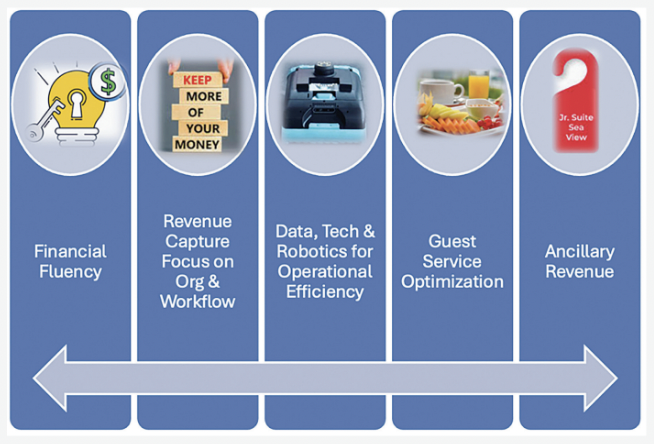
A structured approach to improving profitability can be built around five key pillars, each of which offers potential margin improvements of 1 to 3 percentage points. Combined, they could contribute 5 to 10 points or more in overall profitability resulting in material gains in asset values. If profitable revenue and profitable operations were the industry’s North Star, a reinforced economic foundation leads to stronger real estate development pipelines. Achieving this requires coordinated effort across stakeholders and will result in a healthier ecosystem.
Brands can play a critical role in reducing acquisition costs, enabling ancillary revenue opportunities, refining payment models/cancellation policies, automating tools
for operational efficiency, aligning brand standards with changing consumer preference and owner profitability goals and supporting industry efforts around insurance and tax relief.
Reimagining the Hotel Model
To win, hotels must adopt a profit-first approach for operations, commercial and guest service teams. The latest industry certification, Professional Certificate in Hotel Profit Analysis (CHPA) is built on these five pillars. Created with launch partners AAHOA and HFTP and powered by Kalibri, this online training program offers a foundational course in the fundamentals of putting profit first for operational and commercial leaders.
Financial Fluency
Managers at property, above-property and corporate levels would benefit from more widespread financial understanding of profit metrics and a common vocabulary to align decisions with ownership goals.
Systematic Management of Customer Acquisition Costs
Getting more revenue and pricing it right is no longer enough to achieve owner’s objectives. With costs as high as 20% to 30% of guest-paid revenue, rewarding performance based on revenue net of acquisition costs – Revenue Capture – aligns more closely with profit contribution targets. AI tools for both planning/resource allocation and for execution can continually improve efficiency.
Data, Technology and Robotics for Commercial and Operations
AI and other technology can enhance business mix targeting, forecasting, labor scheduling and operational diagnostics. Automation and robotics can reduce labor
costs in repetitive tasks such as cleaning, food preparation and maintenance, while supporting evolving guest expectations. Expenses tied to business volume-such as utilities, linens and frequently replaced supplies-can be more proactively and consistently managed with the use of technology-driven monitoring systems.
Ancillary Revenue Growth
Hotels can expand optional services, such as upgrades and add-ons, that allow guests to personalize their stay while generating incremental revenue. Team members
can contribute to expanding and delivering these services which may improve guest experience and provide incentives to improve employee retention.
Guest Service Optimization
Guest services can be evaluated frequently to ensure the closest alignment possible between guest expectations and delivery cost while still adhering to brand standards. High-quality guest service will also play an outsized role in the AI models driving bookings.
Key Commercial Issues
Addressing Profit Margins with Shifting Objectives Move from getting more revenue with a focus on price optimization to getting more profitable revenue with a focus on optimizing for a hotel’s most profitable mix. The levers will vary by hotel and market demand profiles and accounts for costs.
Conflicting Incentives for Performance
Successful hotel investors depend on growing profit, but commercial teams earn bonuses based on gross revenue. Topline revenue has also been a dominant factor to evaluate operators for the last 30 years. This disconnect distracts the commercial team from optimizing for profit even when the cost of revenue acquisition has moved from 5% to 20% to 30% and has accelerated since 2010. Managing rapidly rising costs is critical.
Misaligned Performance Metrics
The legacy call for more revenue is now replaced by pursuit of more profitable revenue. Traditional performance measures based on averages of narrowly defined competitive sets were developed in an era with fewer hotels in each market. These tools fail to address revenue quality, nor do they accurately capture today’s wider range of demand opportunities missing large contributors to market share. Understanding composition of a hotel’s business mix is essential to acquire revenue that is accretive to profit.
The Path Forward
There has never been a better time to act. Even with slow revenue growth and rising costs, improving margins and asset value is realistic when profit first techniques are applied to customer acquisition, ancillary revenue, operational efficiency and consistent guest service delivery. With leadership, discipline and a collective commitment to change, the hotel industry can navigate current challenges and build a more resilient, sustainable future.