




"The technology you use impresses no one. The experience you create with it is everything." -Sean Gerety
In the fast-paced world of hospitality, first impressions aren't just about guest experiences, they are equally crucial when it comes to welcoming new team members.
Organizations should view employee onboarding as a strategic process that integrates new hires into their organizations. Doing so requires that onboarding evolves from a simple orientation session into a comprehensive journey that can have a significant impact on an employee's long-term success, satisfaction and retention.
But what does effective onboarding actually look like in practice, and how can technology transform this critical process?
What is Employee Onboarding?
Employee onboarding is far more than filling out paperwork and watching training videos. It's the critical bridge between hiring a promising candidate and developing a productive, engaged team member who embodies the brand's values (Ramirez, 2025). Think of it as equivalent to a guest's arrival experience. It sets expectations, builds confidence, and creates lasting impressions that can extend well into an employee's first year.
True onboarding in hospitality is not a three-day orientation or even a month-long program. It's an ongoing process that can take up to a year to fully integrate an employee into the organization's culture, systems and expectations (Ramirez, 2025). This extended timeline reflects the complexity of hospitality operations and the deep understanding required to deliver exceptional guest experiences consistently.
The Cost of Poor Onboarding
The stakes in hospitality are uniquely high. Unlike other industries where a new employee might have weeks to find their footing, hospitality professionals often interact with guests from day one. A poorly onboarded front desk agent or server doesn't just impact internal operations; they directly affect guest satisfaction and revenue.
Statistics from the U.S. Bureau of Labor Statistics reflect that in the Leisure and Hospitality sector, employee turnover rates have consistently ranged between 70% to 75% in recent years, dramatically exceeding the national average of 47% across all U.S. industries. A 2023 study by the American Hotel & Lodging Association (AHLA) found that replacement costs can reach up to 30% of an individual's annual compensation when factoring in recruitment expenses, training time, and lost productivity.
In this environment, effective onboarding is essential. Every new hire represents an investment in an organization's future and how new hires are welcomed and developed over their crucial first year determines whether that investment pays dividends or becomes another costly turnover statistic.
Given these sobering financial realities, hospitality leaders must approach onboarding strategically rather than leaving it to chance. Success requires a structured framework that addresses the unique challenges of integrating employees into an industry where guest satisfaction depends on every team member's performance from day one.
Beyond the numbers, ineffective onboarding creates a ripple effect throughout properties. Existing staff members shoulder additional responsibilities, guest service quality suffers, and organizational reputation, both as an employer and hospitality provider, takes a hit. New hires who feel unprepared or disconnected often leave within their first 90 days, perpetuating the costly cycle of recruitment and training.

Four C's of Onboarding Success
What can hospitality organizations do to develop effective onboarding practices? In 2010, Talya Bauer developed four fundamental elements known as the Four Cs: Compliance, Clarification, Culture and Connection. Understanding and implementing these components creates a framework for success that technology can powerfully enhance.
Compliance forms the foundation, ensuring new hires understand legal requirements, safety protocols and regulatory standards that are particularly stringent in hospitality. From food safety certifications to emergency procedures, compliance training protects both employees and guests while establishing non-negotiable standards.
Clarification involves helping employees understand their specific roles, responsibilities and performance expectations. In hospitality, where job functions often overlap and teamwork is essential, clear role definition prevents confusion and builds confidence.
This extends beyond initial job descriptions to include understanding career progression paths and development opportunities.
Culture integration represents perhaps the most critical element in hospitality onboarding. New employees must understand and internalize the property's service philosophy, guest-first mentality, and team dynamics. This cultural immersion takes months to fully develop and directly impacts guest satisfaction and employee retention.
Connection focuses on building relationships with colleagues, mentors and leadership teams. In an industry built on human interaction, fostering these connections from day one creates the support network that sustains employees through challenging periods and encourages long-term commitment.
How Technology Helps
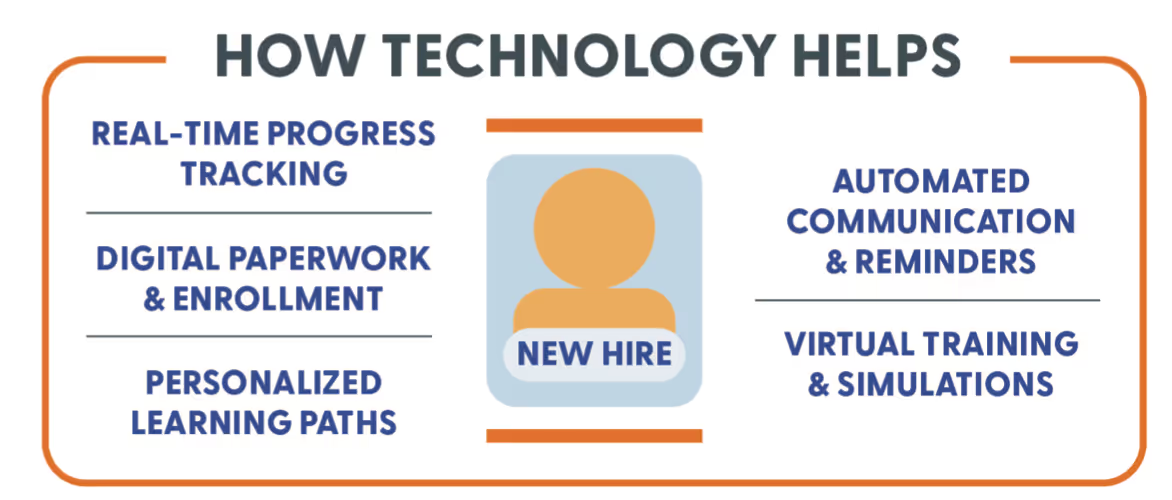
With already limited resources, how can hospitality operations design onboarding programs that deliver the Four Cs effectively throughout this extended integration journey? Recent years have brought significant advances in technology that can help alleviate the burden on some of the traditional onboarding processes.
Rather than overwhelming new hires with information dumps or leaving cultural integration to chance, properties can leverage digital platforms to create personalized, measurable experiences that evolve over time. For example, when new hires complete their paperwork online, the same system can automatically enroll them in training modules, notify their manager of progress, and flag any incomplete requirements, tackling paperwork bottlenecks, scheduling conflicts, follow-up gaps and visibility issues through connected workflows (Jones, 2024). These tools also allow for flexibility as they can be accessed from anywhere, accommodating the diverse schedules common in hospitality.
Virtual training capabilities have transformed how properties deliver both technical and cultural education. New servers can master POS systems through interactive simulations. Housekeeping staff can review cleaning protocols through video modules. All employees can experience the property's service standards through immersive scenarios while tracking progress and identifying areas needing additional support.
Communication technology bridges the gap between formal training sessions and daily operations. Automated messaging systems deliver timely reminders, learning content, and cultural reinforcement throughout the first year. This consistent touchpoint helps maintain momentum in the onboarding process and provides opportunities for timely feedback and course correction.
Perhaps most importantly, technology enables the personalization and tracking necessary for year-long onboarding success. Learning management systems can adapt content delivery based on individual progress, while analytics help managers identify which new hires are thriving and which need additional support before problems escalate.
Imagining the Impact
Consider how a luxury resort might approach its seasonal hiring surge differently. Imagine if leadership implemented a technology-enhanced, year-long onboarding journey.
The transformation begins before an employee's first day. New hires receive digital welcome packages containing property information, virtual tours and access to mobile learning modules covering everything from emergency procedures to service philosophy. During their first weeks, they complete compliance training at their own pace while participating in virtual meet-and-greets with team members across departments.
As they progress through their first months, the technology platform delivers role-specific training, cultural reinforcement content and connection opportunities with mentors and peer groups. Managers receive real-time dashboards showing each employee's progress through the Four Cs, enabling proactive intervention when needed. This visibility becomes particularly valuable for identifying talented hires who possess strong technical skills but may be struggling with cultural integration or feeling disconnected from their teams — employees who might otherwise leave despite their potential value to the organization. Such an approach yields significant benefits. The resort sees reduced first-year turnover while improving guest satisfaction scores as new employees feel more confident and connected to the organization's mission. Human resources teams shift their focus from administrative tasks to strategic relationship-building, and the property develops a stronger reputation as an employer of choice in a competitive market.
The Onboarding Advantage
In today's competitive hospitality landscape, how organizations onboard new employees can become a powerful differentiator. Properties that embrace technology-enhanced, year-long onboarding approaches could see improvements across key metrics while building stronger, more resilient teams.
In hospitality, where a guest's first impression determines everything, the time has come to apply the same strategic approach when welcoming new team members.
The first step is to recognize that effective onboarding can be a competitive advantage rather than an administrative necessity. Technology has made comprehensive, effective onboarding accessible to organizations of all sizes. The question isn't whether technology will transform hospitality onboarding-it's how quickly organizations will adopt these emerging strategies, recalling that the tools are just the beginning, the experience is what transforms.